Tuesday, June 21, 2011

Summer is Upon Us

It hit 80 degrees here about 2 pm today.  The honey bees are happy, corn is growing as are the weeds.
Our Broiler chickens at five weeks in their summer home

I transferred the broiler chickens to their home and pasture.  We'll butcher them this August and they'll dress out about about 4.5 lbs each.  We started with 50 and four have died.  Why, I believe they committed suicide.  Who knows.  The pasture and inside the coop had grass waist high; they ate the grass in their coop down in two days, hungry guys and gals.  Now they are working on the pasture and they are growing well.
Day 2 in their new pen - half of the jungle is gone!

Of our two bee hives, the one in the new boxes are doing very well.  The other hive I kept in an old hive box I bought used.  The queen died and now we have few bees there.  I think I will burn it and start over next spring with new boxes.

The goats are doing well.  We have four boys, all healthy.  I milk their mothers in the morning and let them feed all day on their mothers.  We are getting about a gallon of fresh milk per day.  Making kefir and some other soft cheeses.

We had such a cold and wet spring everything growing is behind except the garlic and the raspberries.  Our honey bees wouldn't come out most spring days and our normal large crop of bumblebees came out late, so we had no pollination on the cherry and plum trees.  Only one of our Asian pear trees (out of four) has fruit.  The apple trees set ok, between two and three apples per cluster of five, which is alright with me as I usually thin to that so we get larger apples.
Mother duck with some of her ducklings in her brooder house
 We have a good crop of ducks this year.  Two mothers have hatched their eggs and we have two setting on nests due any day now.  The first one had 15 and we sold 10; the second one had 10 and we have five of them sold as soon as they feather out.
Oyster Mushrooms growing on a down Alder log

With the cool spring our Oyster mushroom log in the woods was late, but our crop is better than ever.  We gathered about 10 lbs last week, sauteed them and put them in the freezer.  Oyster mushrooms sell for about $10 per pound.  I'll go out there this afternoon and pick some for our stir fry dinner this evening.

Between real estate being extremely busy for me this year, and my building projects (new buck house, new chicken coop ...) I been behind on weed eating and preparing the garden beds.  I have weeds growing into the electrical goat fence and still have three garden beds to weed and turn.  Lots of work to do.  Pam ends her school year next Monday, June 27th, so I'll have more help.  I have not even had time to write, which I love.

Thursday, May 12, 2011

Our Goat Milk-Flow is Back!

Fresh goat milk is back and oh how I missed it.  Normally we leave all of the mother's milk for her kids for the first three weeks, then separate the kids at night and milk the mother in the morning, leaving some for the kids.  With Alure, we are getting about 3.5 lbs each morning (about 8 lbs per gallon).  Nettle gave birth less than two weeks ago and I have been milking her in the morning for the past nine days, and averaging over 4 lbs. per day.  I was concerned that maybe her kids are not eating well (I seldom see them nursing but then I'm away most of the time).  Yesterday I took all of the kids up to Oak Harbor to Ron & Arline's farm (Stonebrier Farm) to have them disbudded and neutered; Arline commented that Nettle's kids looked great and that they were feeding well.  Toots, the first born, weighed in at 18.5 lbs, Puddle (who we thought was the good eater) weighed 16.5 lbs.
Puddle and Toots bouncing around in the goat barn
Rain and Storm watching the new kids
So we once again are making Kefir, our beloved milk drink.  I made some this past winter with frozen milk, it kept the grains alive but they did not thrive.  Oh how they love the fresh milk.  We still have 10 lbs of Pannier cheese in the freezer from last year, many pounds of other cheese, but with two gallons in the refrigerator I need to do something this morning.  It builds up fast.  Last year I was milking four goats and it was a major chore to use all of the milk.  
Nettle has become an excellent mother this year

We named Nettle's two kids Toots and Puddle.  We will be keeping them for meat, butchering them next May.  It'll be interesting to see what our meat total will be with them being half Boer.  We received 90 lbs from the two Nubian bucks we had butchered last month.  Nubians are considered "duel purpose" - very good milkers and also good for meat.  The Boer is a meat goat.
Our apple orchard in full bloom

Our new chicks are doing well.  One of the problems with chicks is called "pasty butt" - their poop clumps up on their butt and can be fatal, blocking more from coming out.  The book says to use a warm wash cloth to remove the clumps.  This is a major chore when you have 70 chicks as we do.  I have found an easy solution: feed them milk every few days.  The milk give them loose bowels and we don't get the pasty poop.  Last Saturday I went in the chick brooder to give them some milk when problems developed.  I have a bungee cord inside to hold the door closed when I'm inside - the hook on the door stripped out at the same time I dumped the milk upside down, scattering the chicks like a bomb when off.  One of our layer chicks fell out the door and ran off into the brambles.  I was running late for a real estate appointment so had no time more time to spend looking for her.  It was 45 degrees out and raining hard, so I logged her as gone.  Sunday afternoon when we returned from Seattle after our Mother's Day gathering, the little check was still alive, scratching around the door.  I put a little dish of food out and when she returned to snack I trapped her with a leaf rake.  She'll be happier with the warm place and plenty of food and water.  I'm also happier with her being back.  I once read the only thing better than happiness is freedom, but this is a farm.

 This Saturday Pam and I are off to Eastern Washington for our annual anniversary and birthday trip.  Our wedding anniversary is May 16, Pam's birthday was May 3, mine is May 17, so each year we do a short trip with Pam taking two personal days off along with the weekend.  This year we rented a place in Winthrop, a small resort town on the eastern sloop of the Cascade Mountain range.  Our friends and neighbors Michael and Prescott will run the farm while we are gone.  It's hard to leave the place when everything is peaking, but once we are away it's fun.

One of our bees working the apple trees
The bees are doing well.  Our apple, pear and cherry trees are in full bloom, along with salmon berries and elder shrubs, so the bees have a lot to draw from.  I love to set in front of the hives and watch the bees come and go.

Tuesday, May 3, 2011

May Day

Nettle licking off one of her new born Boer mix boys
 The last day of April brought two new goat kids onto our farm.  Nettle gave birth to two Boer/Nubian bucklings at 2 pm.  We bred Nettle to EV, our Boer buck, 148 days earlier.  Our goal was to refresh Nettle, one of our best milkers, and hopefully have additional bucks to butcher for meat next spring.  Success!  Just what we wanted.  They both seem healthy, bouncing around and Nettle is being a good mother, not like last year.  Last year, her first, she didn't get it.  I had to hold her feet down to let her kids nurse, and later she killed one, slamming the kid into a wall that was trying to nurse.  I planned on turning her into sausage until I discovered how good of a milker she was.
Windy died Sunday morning about 9 am

After returning from a Beltane potluck dinner at a friend's farm, we bottle fed our little Nubian girl Wendy.  She was normal, sucking down the bottle of goat milk in two minutes.  Sunday morning when I went up to the barn to feed her I noticed something wrong - she wouldn't eat.  She has always been extremely hungry so this alarmed me.  I noticed blood and poop flowing out of her behind so we went into emergency treatment, talked to our vet, and tried to comfort her.  She died about 9 am that morning, just three hours after we noticed her problem.  So quick and sad.  Pam held her as she took her last breath, singing to her a song about passing on to the next phase of her existence.  I buried her in the raspberry patch that afternoon.
Our Cherry trees are finally blooming!
 A goat breeder friend of our told us when Windy's mother first rejected her and wouldn't let her nurse, that often goat mothers will know there is some genetic problem with a kid and reject them soon after birth.  Why waste energy and resources on a kid that won't make it?  Natures way she said.  Of course we didn't want to believe our dear little Windy had a problem.  I guess we were wrong.   Oh well, we have more milk now for the kitchen.  We have four buckling kids for our meat crop this year, and not needing any more does, we are pleased.

I took a beekeeping class on Sunday afternoon and found it interesting.  That afternoon with the outside temperature in the upper 60's I opened the hives and checked things out.  The queen is starting to lay eggs - she will lay up to 1500 per day, and I put in the first mite treatment - formic acid in the form of strips.  I'm told it's the closest thing to organic treatment but can be dangerous to humans and have to be handled very carefully.

Our apple, pear and cherry trees are now in full bloom - much later than past years.  With our new bees I'm hopeful we'll get good pollination. 


Saturday, April 30, 2011

End of April and other things

This last week of April has been full!  I started out bring in the butcher to dispatch two of our male goats, Snowshoe and Stewie.  A friend of ours wanted a buck of hers butchered but didn't want it done at her place so she brought her goat over last Saturday to stay at our place until the butcher arrived.  Being he has never been tested for the dreaded goat disease CAE, we put EV (Extreme Vision) in with our girls - just in case.  EV is our pure bred Boer goat.  He and Snowshoe were born last spring and EV probably is 40 lbs heavier; I can understand why people like the Boer goats for meat.
Snowshoe looking over our friends goat Tank
When the butcher arrived I first led our friends goat out.  He didn't like the experience much and made a lot of noise.  Our goats seemed to understand that it was their destiny, walking gently to the butcher and never made a sound.  It was really awesome.
EV, our Boer goat, made the cut and gets to stay on our farm
 Alure, the mother of our little kids, continues to have problems.  She doesn't like to eat grain, and she needs grain to produce milk.  A couple of weeks ago her morning milk supply fell from an average of 3.5 lbs to 1 lb.  I took her to our vet and she checked out ok.  We did stool samples and drew blood, checked her teeth, had her milk tested...The blood sample came back with a liver problem on one of the tests.  The vet doesn't know what that means, so he sent the information to Washington State University and had one of the professors look at it.  He doesn't know what it means either.
Trying creative ways to get Alure to eat grain - her new thing is to eat directly out of the can
Nettle is due to birth within the next three days.  She is huge, and her utter has filled up (called "bagging up").  Last night we cleaned out her birthing room and have isolated her in there by herself.  She seems to be doing fine.
Pam cleaning Nettle's birthing room last night
Our bees are doing well.  Their hives are all set up and the bees are very busy.  Today I'll do the first mite treatment.  I found a new product just approved in Washington State, called Mite Away Quick Strips.  My bee guy said this is about as close to being organic as you can get, the product consisting of Formic acid.  Formic acid is naturally occurring in honey.  Two strips are added per hive three times per year: now, early September and late December.  Sunday I have enrolled in a beekeeping class put on by Washington State University Extension Service for Island County.  That should be interesting.
EV asking for more grain
April weather on the farm here in Greenbank has been close to normal, except much cooler.  Our rainfall for the month is at 2.1 inches, with some more projected for Monday, but then dry.  This morning we have no clouds and all sun, with highs expected to be in the upper 60's, maybe 70 for Sunday.  Nice!
The three kids waiting to be let out in the morning

Monday, April 25, 2011

Spring has Arrived!

Saturday sure felt like spring has finally arrived.  Near 70 degrees, blue skies, bees buzzing and trees in bloom.  Pam and I worked outside until 7:30 pm, cleaning the barn and doing other chores.  The new bees are working hard, building new comb and out exploring their new territory.  How fun!
The Chicken Coop with its metal roof almost completed

I just about finished the roof of the new chicken coop.  I shorted myself one piece of trim and won't have that until later this week but it's now totally rain proof.  I need to fix the window so I can open it and let in fresh air when it's warm out but not let the chicks jump out.  I'll cover the opening with hardware cloth - metal wire with 1/4" square holes.
View of our chicken and duck area from the roof of the chicken house

Sunday was Easter and we invited the family over for a roast chicken dinner.  Not everyone could attend due to colds and other family commitments, but we had six adults and three grandchildren.  It's fun watching the little ones interact with our farm animals.  Olive, the oldest granddaughter (almost three) loves the goats (her favorite animal) and loves to gather chicken eggs.
Granddaughter Olive playing with Windy

Thursday, April 21, 2011

Chicks Arrived

I received a call from the Greenbank post office yesterday morning at 7 am that they had our box of 67 two day old chicks.  I finished the chicken brooder the night before so was all ready for them.  Off to the post office I went.  Of the 67 we ordered, one chick died.  It was a sex-linked layer chick - we order 15 of them but after I released them all and counted, I still had 17 live ones.  The hatchery must have shipped an extra three.
The Greenbank Post Office with my new chicks insde

The yellow chicks are our new meat birds, Red Rocks, the black our our new layers, Black Sex-Linked
The chicks in their new home
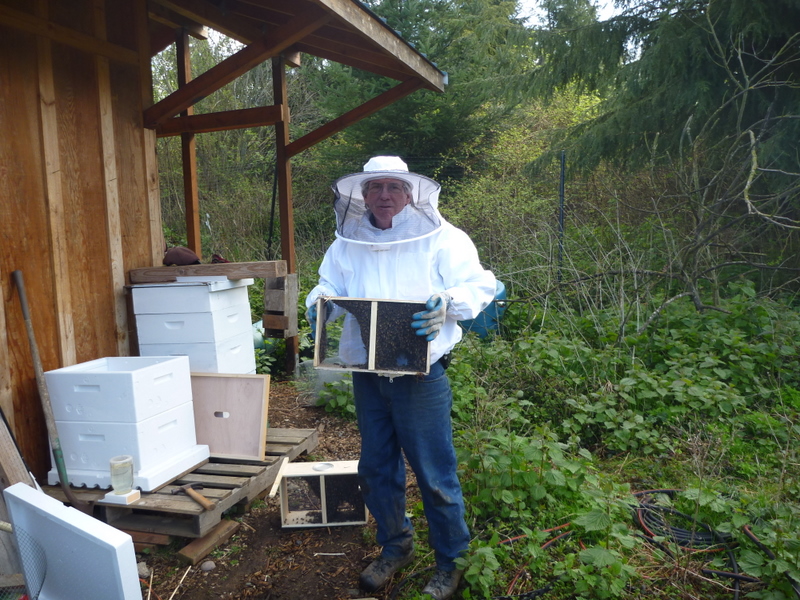
On Tuesday afternoon I opened the bee hives to get all of the new bees out of their boxes and get the queens ready to be released.  I put on my bee suit and had work gloves on but didn't smoke them before starting to work.  Two mistakes!  The bees were not happy with me and I got stung three or four times through my cloth backed gloves.  I put everything down, went to the house and got my heavy rubber gloves and then fired up the smoker.  I started again, first smoking the bees and it was so much better.

Per Wikpedia: "Smoke is the beekeeper's third line of defense (what are the first two?). Most beekeepers use a "smoker" — a device designed to generate smoke from the incomplete combustion of various fuels. Smoke calms bees; it initiates a feeding response in anticipation of possible hive abandonment due to fire. Smoke also masks alarm pheromones released by guard bees or when bees are squashed in an inspection. The ensuing confusion creates an opportunity for the beekeeper to open the hive and work without triggering a defensive reaction. In addition, when a bee consumes honey the bee's abdomen distends, supposedly making it difficult to make the necessary flexes to sting, though this has not been tested scientifically."

 The queen is in a little wood tube.  I removed the cork and inserted a stale marshmallow in its place.  In two days or so the queen will eat her way out and then mate with a drone and begin laying eggs to build up the hive.  I just signed up for a beekeeping 101 class being put on by WSU Extension Service and taught by Timothy Lawrence, one of the nations leading bee experts.

Tuesday, April 19, 2011

Progress

I had a busy week here.  Just about finished the part of the new chicken house in time for the arrival of our 65 new chicks.  We ordered them from Dunlap Hatchery in Idaho.  Today is the shipping day so I'll be receiving a phone call about 8:15 am from the Greenbank post office.  I just have some finishing touches to make, hang the heat lamps and set up the water and food stations.  I'll use wood shavings on the floor.
The new chick coop with the brooding section almost completed
I built the floor about 2 feet up off the ground.  I have found through experience that rats love to live below chicken and duck coops and they will chew through 3/4 inch floor boards.  By raising it at least 12 inches off the ground stops them from nesting there.  I was thinking of using a concrete slab as a floor as it would be easy to disinfect, but a friend told me that he has rats living under his.  I measured the height of our garden cart and thought if the floor was a few inches higher than the cart, it would make cleaning the coop easier.  Just push the material into the cart rather than lifting, so I built it two feet high.

About three years ago when I sold the property across the street (a real estate listing of mine), I arraigned to have a contractor put in a curtain drain in that property.  I thought while they were out I would have them trench three feet deep from our barn to the area where I was planning on building this chicken coop.  I ran a power line and water line from the barn to this area and yesterday connected power to the new coop.  I hooked up a 20 amp circuit breaker (a GFCI breaker) - no more extension cords!  I now have an outlet in the brooding area and can connect the heat lamp directly.
The box of new bees - about 5 lbs
Sunday morning we received two boxes of new bees from a local bee keeper.  I partially took apart the box they came in and put a box in each hive.  Today I'll remove the boxes and take the cork out of the queen's cage.  I'll put a small marsh-mellow in the tube and in a day or so she'll eat her way out of it - then fly to mate with a drone.  Our old hive (the swarm that moved in) died over the winter - which is not unusual for a new swarm.


Gary getting ready to put the box of new bees in the hive
 The bees we received were New World Carniolans.  The New World Carniolan was originally established in 1982 by Susan Cobey and Tim Lawrence in California.  Tim Lawrence is now the Island County Extension Director.  New World Carniolans are a cross between Old World Caniolans (from Germany or Czechoslovakia) and Italians selected for specific traits of gentleness and hardiness.  They are relatively gentle bees and will fly on cooler days than pure bred Italians and winter over in small clusters, which means that they need a smaller amount of honey to get through the winter months.