Sunday, August 21, 2011

Many Hands make Light Work

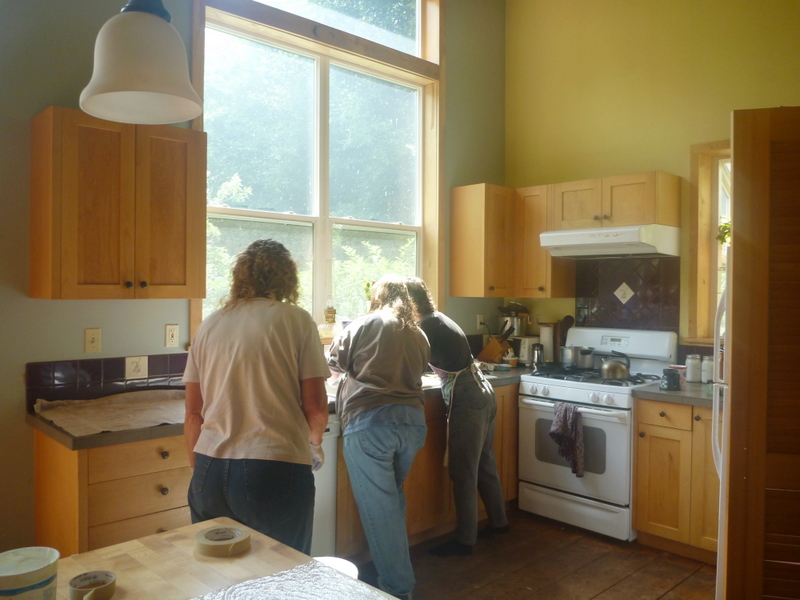
Pam, Merry and Sunni cleaning and wrapping the birds
Pam and I planned on butchering our remaining 26 broiler chickens last Saturday along with three old layers.  Some friends of our wanted to bring four birds to our place to also have butchered that day.  We ended up doing 32 birds and completed the job by 3 pm.  Bruce and I dispatched the birds, removed their feet and feathers while Pam, Merry and Sunni clean, wrapped and weighed them in preparation for the freezer.  A good day for us; not so for the birds.  Oh well, life here is short but sweet.
The newest mother warming her ducklings

The older mother with her nine ducklings after being moved to the bird area

We had another Muscovy hatch some ducklings (7), her second batch this summer - she had 14 her last hatching.  When the ducks come out of the nettle forest with new ducklings I catch them all (including the mother) and put them in a separate pen with their own house, with a small water container and free choice grain. When the duckling start to get their feathers (about four weeks) I move them all back into the bird yard with everyone else.  This time she had less ducklings because I found her nest while she was still in the duckling yard of 12 eggs - no drake in this yard so the eggs were not fertilized.
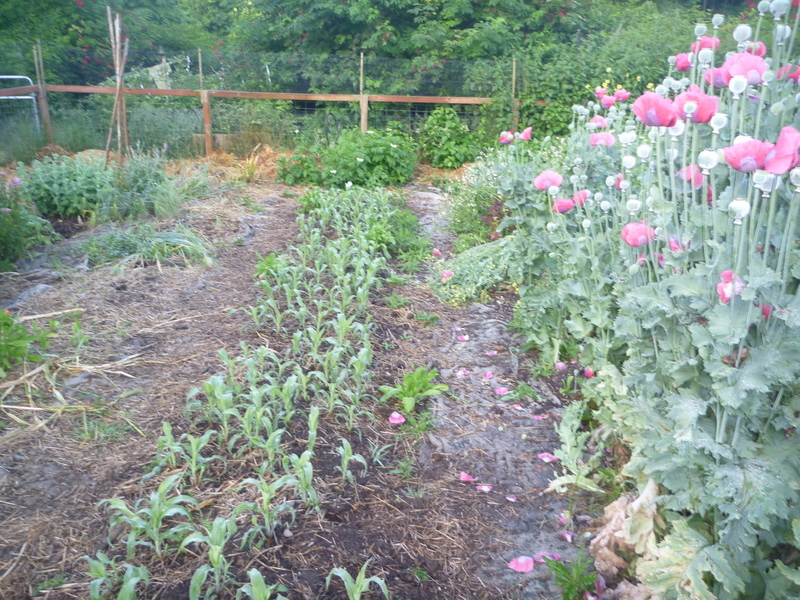
Runner Beans with the summer fog rolling in

The garden is way behind this year due to a cold spring, a very cool summer, and my busy schedule.  Between working on the new chicken coop and real estate being very busy I didn't do a very good job of starting our spring vegetables this year.  I'm not very hopeful about the corn but the runner pole beans might still ripen their crop.  Cool season crops have done very well.  We had great garlic, broccoli and cauliflower crops, potatoes are yet to be dug (another couple of weeks but before the rains return), but I planted the onions late so they are way behind.

Our typical summer day this year has been fog or a low marine cloud layer every morning with afternoon sun.  The sun has been warm once it burns off the clouds with highs in the low 70's.  Yesterday was a treat with the temperature in the 80's most of  the day.

I have the third part of my beekeeping class this afternoon and several questions for the instructor.  How do I prevent swarming?  How do I combine two hives?  What are good flowers to plant for the bees?  I want to combine two of the swarms I captured late in July and I want to build a bee garden near our house.
Pooh Bear with his best friend, Surely

We are milking two of our goats and have been getting about two gallons of milk each day, 3/4 of a gallon from Alure and 1.25 gallons from Nettle.  The boys are doing well, Surely is bred (due in the beginning of January), and Pooh Bear is living with his best friends, the goats.
Our Compost entry in the Island County Fair won first prize

We entered 16 items in the Island County Fair last week and won 14 blue ribbons.  Our compost and mint won best of the show in their groups.  I watched as the judge for compost used ours as an example of how she judge compost.  We have great compost, with our garden debris, goat and chicken bedding (with manure), leaves and the debris from my landscaping business.  We have three piles, never turn them - just let them rot.


Sunday, August 7, 2011

August on the Farm

Surely is in heat and has moved in with our buck
Yesterday Pam and I cleaned out the buck/kid barn and noticed that EV, our Boer buck was starting to smell like a buck in rut.  It's a strong, sweet odor, the first sign that fall breeding time is around the corner.  This morning Surely, our best milker that didn't take last year and is dry, was at the buck gate, her tail wagging (called flagging) and talking to EV.  I let her through the gate and sure enough, she was in standing heat.  Standing heat is where the doe will stand still and let the buck mount her.  Ovulation (the dropping of the eggs to be fertilized) in the female occurs 12 to 36 hours after the onset of standing heat.  I saw EV mount Surely three times but we'll let Surely stay in with him for 10 days or so.  Sometimes the eggs don't drop and she'll go into standing heat again - and I don't want to miss that.  If she settles this time we should have her babies January 3rd.
Pooh Bear taking another nap
Pooh Bear wasn't interested in the racket, just wanted to get more rest.
Mother Muscovy with 10 ducklings teaching them how to grab flies out of the air
Our Muscovy duck has 10 ducklings that are about ready to be sold.  We get $7 each for them at this age, $15 when they are fully feathered out, and $20 at six months.  If we sell a laying duck we get $25.  What we don't sell we'll butcher.
One of our new Sex-Linked hens

Egg production has really fallen off, from the peak of 12 eggs a day to three or four.  Our layers are going into their third year and they need to be replaced.  Our new flock should start laying next month and we'll butcher the old girls next spring.  Our plan is to add 15 each year and remove 15, keeping our laying flock at about 30.  Next weekend is our butchering day for the remaining broilers and we plan on including our two Rhode Island Red roosters.
A Sex-Linked Rooster - sex-linked is a cross of Rhode Island Red and Bared Rock

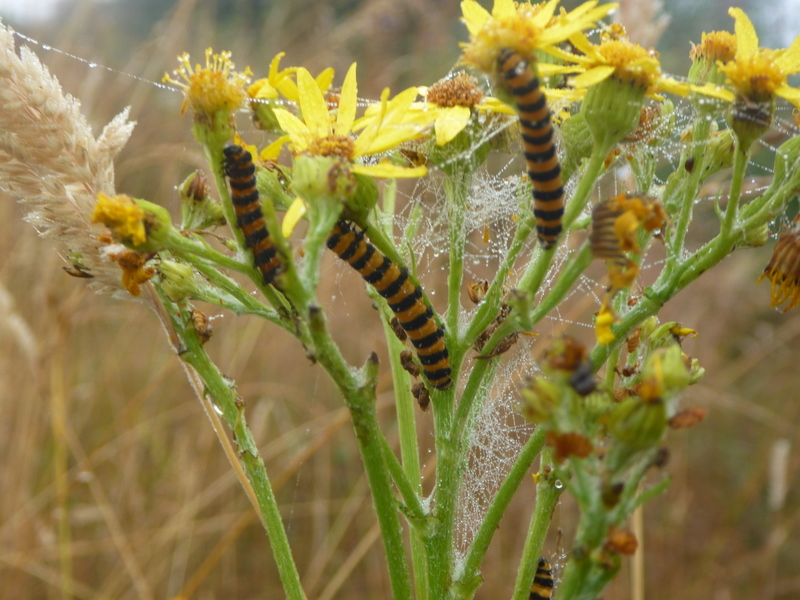
A nasty weed growing around here is Tansy ragwort, an invasive, toxic biennial weed from Europe most often found in pastures and along roads and trails.  It is a Class B Noxious Weed in Washington State and control is required.

Tansy Ragwort with the Cinabar larva eating away

When prevalent, tansy ragwort is on of the most common causes of poisoning in goats, caused by consumption of the weed found in pasture or hay.  Milk produced by affected goats can contain toxins.  Most goats will reject it, bukt some will eat it, especially if it is in their hay; its poisonous alkaloids are unaffected by drying.  Honey from tansy ragwort also contains the alkaloid.


They will strip the plant of leaves and flowers

The good news is the appearance of a moth that lays its eggs on tansy, called the cinnabar moth.  Spectacular success has been achieved controlling tansy ragwort in the Pacific Northwest region by releasing this animal, and we have it occurring naturally around our place.  In places where we don't see them we just pull the plant when it is flowering and compost the plant after cutting off the flowers.  Our compost pile is very hot with all of the goat manure and urine, so it can probably take the complete plant.

Friday, August 5, 2011

A Very Good Life on the Farm, and One Bad Day


EV, our Boer Buck with two of his Nubian/Boer kids in the Buck Yard
An interesting day Sunday was.  It started off separating the goat kids from their mothers.  I finally corrected the drainage problem around the buck house, putting in a curtain drain and gutters on the structure.  The day before I cleaned out all of the old bedding straw, putting in fresh material.  I put in EV, our Boer buck, and the four weathered boys this Sunday morning.  Between the boys screaming for their mothers and their mothers screaming for the boys, we had much noise and little peace.  Pooh Bear, our guardian livestock dog, slept through it all.
Alure and Nettle, our two Nubians that we are milking this year
Sunday was also our chicken butchering day, with our goal to process all of the male broilers.  The night before Pam and I picked up the chicken plucker from our friends at the Blue Feather Farm in Clinton.  The set up takes me about a hour, which we did near the house where we have outside hot water.  Then the process of going up to the broiler house, grabbing a rooster and walking down to the processing area.  About 300 feet each way - 20 round tips.  The chicken I would grab was very upset, but as I made the trip down to the house I talked to each one, holding him close to my chest, thanking him for sharing his life force with us.  By the time I was half way to the house they would be totally calm and accepting of their fate.

The Killing Cones set up for 4 birds
We had a setup of four killing cones on a sawhorse, I would put the chicken in upside down, allowing the blood to rush to their head.  I then use an X-acto-knife to cut the throat and bleed into a bucket.  By the time I had the next chicken brought down the one before would be dead.  When I got three dispatched, I then submerged them one at a time in a pot of water, 140 degrees, for one minute.  Then into the chicken plucker where I removed their feet (the feet are reserved for future chicken stock).  About one minute or so and all of the feathers are gone - then into a metal trash can filled wit ice water.  Pam comes out and takes them one at a time into the house where she cleaned, wrapped and weighed them before putting them in the freezer.  20 chickens took us just about the full day.

My set up
The inside of the plucking machine
The birds averaged 4.5 lbs, down a pound from last year.  We changed feed this year and last year we let them grow longer.

Saturday, July 23, 2011

Mid Summer on the Farm

Yes, they say it is summer but this is one of the wettest and coolest I remember in a long time.  Several days this week we had thick cloud cover, drizzle, and temperatures never reaching 60 degrees.  Thursday was especially bad as I did pruning off the Island all day in heavy rain.  After we completed our evening walk we were treated to one of the most beautiful rainbows I've ever seen - then a second one appeared.  I was about to feed the goats their evening snack and just couldn't break away from looking at the rainbows, when two ravens flew through it.  Oh my, I thought, this makes up for the crappy weather!
Some of our Garlic ready to hang to cure
Pam dug the garlic out - a very good crop this year of large heads.  She'll tie bunches of six heads or so and we'll hang them on the rafters of our front covered porch to cure in the shade for a month or so, then clean them up and store them in mesh bags.  The garlic will last us until the next harvest.
Our Buckwheat Bed with squash and carrots
Pam watering the corn last night

We have two vegetable beds we never planted this year so I planted buckwheat in them.  Buckwheat is a good summer cover crop and the bees will love the flowers.  Speaking of bees, we have another swarm in our garden.  I sure hope it didn't come from our main hive!
Bee Swarm on our Garden Fence

We decided to replace our drake (male duck) named DJ.  I'm going to miss him, he is so mellow but a great rater.  When rats come into the duck house at night to share in their grain, he grabs them and drowns them in the water bucket, either leaving them in there or throwing them out.  Our problem is that two of our female ducks are his daughters and many of their ducklings have died from unknown reasons.  We are guessing that the cause is inbreeding. 
DJ (Don Juan) our Drake
The new chicken house with a chicken starting to lay her egg in the smallest nest - also the most popular!
All of the chickens are now living in the new house now.  I have the old one locked up and when time permits I'll tear it down.  I'm going to keep two of the posts that are set in concrete and turn them into Scarecrows.  Scarecrows have been successful at our farm in protecting our birds from eagles and hawks.
Steam raising from our compost pile behind the fence

Tomorrow we'll be butchering half of our meat birds - all of the males.  We have about 45 in total.  We'll let the hens grow with the boys for two weeks and then process them.  Tonight I'll remove the feed just leaving them water to clean out their intestines.  We did 45 last August and still have nine in the freezer - so this is a good number for us.

The Broilers in their summer home
The Broiler Chicken Yard
We don't use the popular 'Chicken Tractor' concept.  Though the chicken tractor is better than cages, I prefer to let my birds run in the pasture.  Our birds have plenty of space to search for bugs and weeds and get very good exercise.  I've seen other people's chicken tractors and believe they are not much better than living in a small cage.  We lose very few to predators.

Tuesday, July 19, 2011

Honey Bees

I was in the garden last Thursday watering the bee balm plants and could hear the honey bees  buzzing but couldn't see them.  I thought that was odd and looked up into our apricot tree and saw a swarm of bees hanging.
A Swarm of Honey Bees in our Apricot Tree
I assumed it came from our hive as when honey bees swarm they don't go far at first from the hive and I don't know of any other bee keepers within a mile of our place.  I've been meaning to order new hive boxes as I prefer to have more than one hive but have not done so.  I do have two honey supers in storage that are brand new, so decided I could use them as a temporary home until I order a new set of boxes.
The Swarm of Bees up close
Bees swarm as a natural form of hive splitting and growing.  When the bees in a hive believe they are filling up the space available, the queen starts laying queen eggs.  The worker bees feed these eggs a special food (royal jelly) that will allow these eggs to grow into a fertile female.  Shortly before the new virgin queen emerges from her cell, mama queen flies off with 50 to 60 % of the workers.  They will land on a nearby tree to rest while worker scouts fly off to find a new home.

I got my ladder out, set up the new temporary home, put on my bee suit and climbed the ladder.  I sprayed sugar water on the swarm to calm them, placed a five gallon bucket under the swarm, and shook the branch.  Almost all of the bees fell into the bucket.  The queen is usually in the center of the cluster.  I then pored the bees from the bucket onto the top of the hive and put the lid on.

About five days latter (yesterday) Pam and I were cleaning the goat barn, hauling the spoiled straw and bedding to our compost piles, when we both heard thousands of bees.  I went over to our established hive and saw thousands of bees coming out and flying over to a place in our orchard.  In the orchard they were all gathering, forming a funnel of bees forty to fifty feet high.  Another swarm was forming in front of our eyes!

It's very rare for a hive to have two swarms within a week unless there is something wrong with the existing hive and the bees are all moving out.  I went in my existing hive and all is well.  Our established hive looked very good, with many bees, frames of honey and brood.  My guess now is that the first swarm I caught was from a local wild hive.

I found the swarm in a hemlock tree outside our orchard, took one of the honey suppers and set up another temporary hive, and caught the swarm like before.  Now we have three hives, two in temporary quarters.  July swarms are not known to be strong with little time left to build their winter stores.  I'll help by moving some of the brood frames from the established hive to the new ones, start feeding them sugar syrup, and hope for the best.

Monday, July 11, 2011

Summer on the Farm

My typical summer day starts about 4:30 am when I get up.  I like to run when it is dark out, so three times a week I rise at 4 am to get my run in before starting the farm chores.  5:30 am I'm out working the birds, changing their water, topping off their feed and watering the garden.  I then feed and milk the goats.  I'm usually back in the house with the fresh goat milk by 7 am, strain it and let it set in the sink in an ice bath.  Our goal is to get the milk chilled to about 40 degrees within an hour, then it goes into the refrigerator.
Runner Beans
Potatoes and Sweet Peas
Our garden is doing okay this year, below average.  The runner pole beans are looking very good and we should have a good crop this year.  We grow two beds each year letting the beans mature and save them for the future.  Runner beans are very large and we use them in recipes that call for Lima beans.  Two beds of 8 sets of poles will give us about a gallon of dried beans plus our seed for next year.  The flowers attract humming birds and the honey bees love them.
Corn is way behind this year
Our corn is usually knee high by the 4th of July - today is the 11th of July and they are only half way to my knee.  I fertilized them this morning and watered.  Unless we have a very worm summer I don't believe we'll have fresh corn.  Potatoes are looking very good, as is the garlic.  The garlic will be dug up by the end of this month, tied together in groups of six and hung under our porch to cure.  Sweet peas are late but starting to produce well.
The Meat Birds are doing very well
 

I'm just about done with the inside of the new chicken coop - I still need to put an electrical outlet in the main room so we'll have winter light.  Once the days become shorter I'll put in a timer so the light goes on about 4:30 am until the sun rises.  The idea is to get the chickens to eat more (with the light on they wake up and eat).  The more they eat the more eggs they lay.
Our newest Mother with 12 day old ducklings
Yesterday our newest duck came out with 12 ducklings.  Moved her to the duckling pen where they will grow until feathered out.  We give them free choice grain during this growth period.  We have 26 ducklings living here now and have sold 10.  I have one duck on a nest and one laying eggs in another nest.  The Muscovy will usually set twice during the summer - so we get a lot of ducks!  I will sell all of the females and most of the males - keeping 10 or so males for the freezer.  We sell the day-old ducklings for $5, once they are feathered out the price goes to $7, full grown females are $25.
The New Coop, with siding still to do

The Egg Condo

We bought a new dehydrator, one with a fan and temperature control, and large enough to put my cheese in.  In the past I have been letting the cheese set a warm oven (warm when I first put in the milk) but with the new dehydrator I can set the temperature at 90 degrees and it stays there.  My last two batches of Chevre have been excellent.
Cheese setting in the dehydrator

Tuesday, June 21, 2011

Summer is Upon Us

It hit 80 degrees here about 2 pm today.  The honey bees are happy, corn is growing as are the weeds.
Our Broiler chickens at five weeks in their summer home

I transferred the broiler chickens to their home and pasture.  We'll butcher them this August and they'll dress out about about 4.5 lbs each.  We started with 50 and four have died.  Why, I believe they committed suicide.  Who knows.  The pasture and inside the coop had grass waist high; they ate the grass in their coop down in two days, hungry guys and gals.  Now they are working on the pasture and they are growing well.
Day 2 in their new pen - half of the jungle is gone!

Of our two bee hives, the one in the new boxes are doing very well.  The other hive I kept in an old hive box I bought used.  The queen died and now we have few bees there.  I think I will burn it and start over next spring with new boxes.

The goats are doing well.  We have four boys, all healthy.  I milk their mothers in the morning and let them feed all day on their mothers.  We are getting about a gallon of fresh milk per day.  Making kefir and some other soft cheeses.

We had such a cold and wet spring everything growing is behind except the garlic and the raspberries.  Our honey bees wouldn't come out most spring days and our normal large crop of bumblebees came out late, so we had no pollination on the cherry and plum trees.  Only one of our Asian pear trees (out of four) has fruit.  The apple trees set ok, between two and three apples per cluster of five, which is alright with me as I usually thin to that so we get larger apples.
Mother duck with some of her ducklings in her brooder house
 We have a good crop of ducks this year.  Two mothers have hatched their eggs and we have two setting on nests due any day now.  The first one had 15 and we sold 10; the second one had 10 and we have five of them sold as soon as they feather out.
Oyster Mushrooms growing on a down Alder log

With the cool spring our Oyster mushroom log in the woods was late, but our crop is better than ever.  We gathered about 10 lbs last week, sauteed them and put them in the freezer.  Oyster mushrooms sell for about $10 per pound.  I'll go out there this afternoon and pick some for our stir fry dinner this evening.

Between real estate being extremely busy for me this year, and my building projects (new buck house, new chicken coop ...) I been behind on weed eating and preparing the garden beds.  I have weeds growing into the electrical goat fence and still have three garden beds to weed and turn.  Lots of work to do.  Pam ends her school year next Monday, June 27th, so I'll have more help.  I have not even had time to write, which I love.