Saturday, July 21, 2012

Fruits of the Farm

We have two raspberry rows about 30 feet long. I started in 2003 with some plants we brought to the Island from our home in Poulsbo from plants Pam received from a friend.  They have done well and we would freeze about five or six gallons of them for use during the year, usually put on my morning oatmeal.  I tried growing boysenberries in a row next to the raspberries but that was a disaster - it was like planting wild blackberries - except the birds loved them and would start eating the berries just before they were ripe.  I dug them out, potted them up and gave them away.  We then bought more raspberries and planted a second row.  We did well again last year with some berries from the new row, but this year they really took off.  We had a warm and wet May and the berries loved it.  We have been picking for two weeks now, about five gallons of berries every two day - I estimate that we have frozen over 40 lbs so far this year!  We had to fence the area from our chickens as they discovered they could walk down the top of the canes and eat the berries, then when the berries were gone they would eat the new canes (next year's fruiting canes) just as they were coming up.  We are about 2/3'rds of the way through our crop but with the wet July we are having, some of the berries are molding.  Most of the berries are so large they look like strawberries.
Our Raspberry Patch in 2011 has really matured
Harvested the garlic these past few days.  My favorite is Pink Music, a variety few have heard of.  I love it because the heads are the size of a baseball, have about six cloves which are very large, is easy to peel and has a very good garlic favor.  This year's crop of Pink Music was excellent and I planted four times as much as the other four varieties I grew.  The others were okay in size, what I would call "average".  I'm not willing to grow only one variety though.
This Years Garlic hanging on our front deck to cure

We are picking sugar snap peas and because we start late and do two planting we should have them until late summer.  New potatoes are being dug, broccoli, cauliflower and cabbage are mature.  Our onions have developed purple blotch due to the cool and very wet July we are having.  When I first saw it two days ago I sprayed with Neem Oil, a natural fungicide, then the next day with Lime/Sulfur, also an organic fungicide.  We are hopeful that they will recover.  I never recall having a July like this one, with nearly two inches of rain this month already.  We in the Pacific Northwest are use to wet winters and springs, but summer is usually dry, even though sometimes cool.  We have had two weeks of thunder storms with on-and-off heavy showers.
Onions with Purple Bloch
The Corn Bed

Our early corn with the beginnings of tassels
I opened the bee hives the other day and in our best hive we have half of a honey supper filled - so far about 20 lbs of honey that I can harvest when I return from a camping trip next week.  This is good as the wild blackberry is blooming - so we might get another 20 lbs before the summer is over.  The wild goldenrod is about ready to bloom and the bees also love that flower.  We now have three bee hives, one really strong and two no so.  I'll re-queen later this summer so we'll be going into winter with three strong hives.

Saturday, July 14, 2012

Our Chickens

We raise chickens for eggs and meat.  We started out with 15 Rhode Island Reds, a breed I've always liked but never raised before.  That was about four years ago.  Over time birds died and in 2011 we added 15 Black Sex-Links.  The Black Sex-Link is a cross between a Barred Rock and a Rhode Island Red.  They call them sex links because the males look something like a Barred Rock and the females are solid black.  We received them in April of 2011 and by August they were laying huge, dark brown eggs.  My egg customers went crazy over these new eggs.  The Rhode Island Red eggs looked small and faded out in color compared to the sex link egg.  So this year we added 15 Golden Sex Links to our flock.  The plan is to butcher our layers after three years and by keeping different breeds it allows me to know how old they are.

Our Black Sex-Link Layers getting outside in the morning
When I was a kid I remember seeing chicken in the store for sale called "Stewing Chickens", usually less expensive than broilers.  No more, as the commercial egg growers now use a very small chicken and when they are past their prime egg laying time they get turned into pet food (the completed bird, feathers and all).  These old layers need to be used in some type of soup or stew, but when cooked for a long time they make a wonderful dish.  The meat stays firm compared to using a regular broiler, which gets mushy.  Once you taste the difference you don't want to use a regular chicken in one of these dishes.  Last week our plan was to butcher the balance of our Rhode Island Reds and I had commitments from customers for all of them at $5 per pound.  Turns out we didn't sell any of them but gave them to friends and kept one for ourselves.
Our Black Sex-Link Rooster

Last year we changed our feed for our broilers to a soy-free product and our average production fell from 5 lbs. per bird to 4 lbs. We buy our feed in 320 lb barrels as part of a small co-op, getting wholesale prices and pay a small delivery charge.  Results from other growers in the co-op were the same or worse, some of the growers had chickens with major leg problems.  This year we went back to the old company and our average production increased to 6.1 lbs per bird and they consumed the same amount of grain.  We had many that dressed out nearly 7 lbs., and one at 7.1 lbs.  We were very pleased as we like a large bird.  These are not your commercial broilers that do nothing but set and eat grain, not knowing what to do with a bug if they found one.  Our flock was truly free range, going out into a pasture to eat weeds, grass and bugs during the daytime.  We received them about the 6th of April, 11 weeks later butchered the first half (chose the larger ones).  The second 25 were butchered a week after that.  So our freezer is full, with cheeses, berries, goat meat and now chickens. Next project: firewood.
The chickens eating fresh weeds from our garden

We cooked one of the new, large broilers a few days ago and it was wonderful.  Almost melted in your mouth.  Tender and juicy with a flavor unlike store bought chicken.

We ended up with 41 broilers out of 50 that we started with, about 10 were females, and 249.5 lbs of broiler meat for the year.  Average weight per bird was 6.1 lbs.  They ate about 1000 lbs of organic grain at a cost of about 30 cents per pound; worked out to $7.32 per bird or $1.22 per pound.  Very good for an organic free-range chicken - local farmers I know charge $5 per pound for organically pastured raised broliers.  It takes us about 32 hours to process the birds, and very little time to raise them.  Usually we have friends help with the processing which makes it a four hour day split into two days.  I wonder how many pounds of grain the rats ate?  Next year I'm going to bury hardware cloth to keep the rats out of the broiler coop at night.  One of the dark sides of raising farm animals is rats.

Today's project:s: making blue cheese, raising the buck area fences that connect to the girl's area, and going into the three honey bee hives.

Note: If you live on South Whidbey Island and re looking for farm raised broilers, check out Joli Farm.  Here is the post from the Grange Food News:  
Joli Farm, Freeland, which sells Whidbey Island Eggs at Bayview Market will be selling broilers soon. The birds are Red Rangers, pasture raised  and currently 9 weeks old. If you order birds, they will be custom processed in the on-site WDA licensed processing plant, at around 11 weeks of age, that’s two weeks from now.  So call 331-5058  and get your order in.
Most people I know who are raising  broilers are just doing  it for themselves and a few friends. So it is great to have local pasture raised birds available again for public sale.

Friday, July 13, 2012

Pooh Bear - Our Livestock Guardian Dog


Pooh Bear, our Livestock Guardian Dog (LGD), who we have had for four years, died a little over a week ago.  Quite a shock to us with him being so young.  We noticed that he was getting a little thin so I increased his food, but other than that, he had been doing very well.  Eating well and going on a two mile walk every evening with our other two dogs.  Pam went to check up on  the goats about 10 am and found him down on the ground making some strange noises, called me, and I rushed home to help her load him into our car.  The vet said he had a tumor on his pancreas and it was limiting the amount of insulin flowing into his body.  I loved Pooh more than any dog I've ever had.  So sad.

Pooh Bear was a Great Pyrenees dog that we got to protect our goat herd, mostly from coyotes.  Our goats live in a fenced area that we are nearly 100% sure is safe from these wonderful predators, but for a goat there is probably no worse way to go than to be taken down by a coyote.  Our fencing is very good, with five foot woven fence mesh and a hot wire on top.  Surely, the goat in the picture with Pooh, were best friends, and were often seen laying together.

Meet Mishka, our 11 week old Great Pyrenees puppy.  It takes a puppy about 16 months to mature into a force that can defend livestock, so we thought we should get started at once.  Mishka means White Bear in Russian.
Mishka, 10 weeks old and learning his job
The goats didn't like him much, with Alure stalking him, but with over a week now everyone seems to be adjusting fine. The yearlings took to him quickly, as did EV the buck, but the milking girls were not fast to warm up to him.  For two days our milkers wouldn't eat their grain.  He spends his time between being a puppy and watching the herd from a high spot.

Yes Pooh, we will never not remember you!

Tuesday, November 15, 2011

Fall 2011

The official rain year runs September 1st through August 31st each year.  Our normal rain fall for Greenbank is about 18 inches (we are in the Olympia Mt Rain Shadow).  Last year we measured 30.8 inches at our farm.  Yes it was a wet year.  Fall has been very nice and dry this year, with only a fraction of the amount of rain that we had last year.  Because of all of the sun we have one of the best winter gardens ever.  Four beds of greens, beets and carrots.  This last Saturday evening Pam made our dinner consisting of fried chicken gizzards, baked potatoes, and a roasted beet salad with goat cheese.  Other than the spices and olive oil, everything was from our farm - and completely organic.  We couldn't have bought a better dinner at a fine restaurant.
One of our fall/winter garden beds

We had a good apple harvest, with 8 - 25 lb buckets from our trees.  These are being dried for late winter when our frozen fruit is gone.
Our goats are doing well, with three of the does bred, one to go.  Surely is due January 3rd, Alure is due February 11th, and Alder Rose is due March 5th.  The next time Nettle goes into heat we will breed her, so she give birth mid to late April or in May.
Our four does with Pooh Bear

Some of the boys eating their morning grain.  We'll butcher the four boys next May
Our milk flow has been outstanding this year.  Both Nettle and Alure are in their second year (the saying goes, never judge a doe on their first year), Nettle has averaged 1 gallon per day and Alure 3 quarts since late July when we separated them from their kids.  Nettle peaked at about five quarts for a couple of months, Alure a little less than a gallon.  We are beginning to dry off Alure as we want her to "rest" for two months before she births in February.  Nettle should continue to produce through February, about the same time we'll start receiving milk from Surely.

One of our staples we make with all of this milk is Kefir.  We add, fresh from the goat, milk to about 1/2 cup of live kefir grains and let it sit on the kitchen counter for two to three days, strain out the grains and put the finished kefir in the fridge.  I keep four quarts going all of the time.  We use the kefir on our morning cereal in place or with milk, and also drink a cup in the afternoon as a snack.

"Kefir is a cultured milk drink that has been used for thousands of years. It is made by adding kefir grains to fresh milk and then letting it set at room temperature for 24 hours - strain out the grains and it's completed. It has a light, bubbly sparkle and is often referred to as the "champagne of milk." Traditionally it is made with live grains, and its unique flavor comes from the combination of bacterial acidification (creating a wonderful probiotic supplement for intestinal and immune health) and alcohol produced by yeast during the fermentation process. With proper care the grains continue to grow and sustain themselves."
Straining our Kefir
The kefir ready for today's milk

Our garlic has been planted.  My favorite variety is Pink Music, a hard neck garlic.  Our heads are huge, the size of a baseball, with only five to seven cloves.  The individual cloves are almost the size of a garlic head you would buy in the store, are juicy and have a strong garlic flavor.  This is a true garlic and is easy to peal.  I have been growing it for 15 years, saving the larges heads to plant in the fall.  I gave some to an Italian friend of mine and he said it was the best garlic he has ever had - and he has had lots in his life.  We grow six varieties in a raised bed 5 feet wide by 30 feet long.

Nettle finished being milked in the milk stand

Pharaoh our barn cat waiting for her morning goat milk

Pooh Bear lives full time with the goats


Wednesday, September 14, 2011

September

We are half way through September and summer had finally arrived.  August was dry with only a trace of rain, but lots of morning fog keeping the days cool and in the low 70's.  The last week of August and the first 10 days of September we sunny and in the upper 70's to low 80's, but we are back to clouds and 60's.  I'm hopeful that we will still have ripe fruit, corn and beans.
Bees on our Sunflowers

We have 20 ducks as I have been unable to sell our excess ones.  This weekend I am going to move all of the males except our one breeder into a separate pend where I will give them free choice grain to get them ready to butcher in another six weeks.  Two of our goats have been bred and the two I am milking are still producing two gallons a day.  I've been making lots of cheese and we are sharing our excess milk with four other families.
Junior, our young Rhode Island Red Rooster

Our Boer buck is gentle but wants to play.  At over 200 lbs it can be scary.  I bought a close in livestock prod to carry with me when I'm cleaning his barn.  It's a hand held small unit with two brass probes - you push a button and stick the probe into his ribs.  It gives him a shock, enough to make him run off but not scream.  After three jolts all I had to do was press the button and he would run off - it gives off a light sound when activated and he has associated the sound with the jolt.
One of our Buckwheat beds in full bloom


This years corn might still ripen
One of our compost containers that we have been using this year.  The compost is 1 1/2 years old
 Our vegetable garden has done well with all of the cool season crops doing excellent.  After we dug all of the potatoes I turned the bed, added four inches of compost and then covered the bed with another four inches of bedding/manure from the goat barn.  That bed is now ready to set for the winter.  Come spring I'll turn it under.  The runner pole beans are getting large and if winter holds until November we'll have a good crop.  Some of the corn ears are getting really big so just maybe...  We have most of our winter crops in the ground with some of the faster growing ones still in flats.  They will go in this weekend.  I am still picking sugar snap peas and have at least one more picking before that crop is finished.  I have never had peas later than the first week of August.  What a strange weather year we have had.
Sugar Snap Peas in early September
Sugar Snap Peas are still producing well

Our Akane apples are one of my favorites, usually ripping early August.  They are large, sweet with a little tart taste.  They have turned red now and are about a week from being ready.  Blackberries are beginning to ripen (the wild blackberry is a noxious weed in our state but my favorite noxious weed!).  We have picked about four gallons for the freezer so far.  If the rains hold off we still may get another couple of gallons.  Once it rains the berries become so full of water you can't pick them. 
Akane apples are almost ready

Honey bees are active but no excess honey for us this year

Sunday, August 21, 2011

Many Hands make Light Work

Pam, Merry and Sunni cleaning and wrapping the birds
Pam and I planned on butchering our remaining 26 broiler chickens last Saturday along with three old layers.  Some friends of our wanted to bring four birds to our place to also have butchered that day.  We ended up doing 32 birds and completed the job by 3 pm.  Bruce and I dispatched the birds, removed their feet and feathers while Pam, Merry and Sunni clean, wrapped and weighed them in preparation for the freezer.  A good day for us; not so for the birds.  Oh well, life here is short but sweet.
The newest mother warming her ducklings

The older mother with her nine ducklings after being moved to the bird area

We had another Muscovy hatch some ducklings (7), her second batch this summer - she had 14 her last hatching.  When the ducks come out of the nettle forest with new ducklings I catch them all (including the mother) and put them in a separate pen with their own house, with a small water container and free choice grain. When the duckling start to get their feathers (about four weeks) I move them all back into the bird yard with everyone else.  This time she had less ducklings because I found her nest while she was still in the duckling yard of 12 eggs - no drake in this yard so the eggs were not fertilized.
Runner Beans with the summer fog rolling in

The garden is way behind this year due to a cold spring, a very cool summer, and my busy schedule.  Between working on the new chicken coop and real estate being very busy I didn't do a very good job of starting our spring vegetables this year.  I'm not very hopeful about the corn but the runner pole beans might still ripen their crop.  Cool season crops have done very well.  We had great garlic, broccoli and cauliflower crops, potatoes are yet to be dug (another couple of weeks but before the rains return), but I planted the onions late so they are way behind.

Our typical summer day this year has been fog or a low marine cloud layer every morning with afternoon sun.  The sun has been warm once it burns off the clouds with highs in the low 70's.  Yesterday was a treat with the temperature in the 80's most of  the day.

I have the third part of my beekeeping class this afternoon and several questions for the instructor.  How do I prevent swarming?  How do I combine two hives?  What are good flowers to plant for the bees?  I want to combine two of the swarms I captured late in July and I want to build a bee garden near our house.
Pooh Bear with his best friend, Surely

We are milking two of our goats and have been getting about two gallons of milk each day, 3/4 of a gallon from Alure and 1.25 gallons from Nettle.  The boys are doing well, Surely is bred (due in the beginning of January), and Pooh Bear is living with his best friends, the goats.
Our Compost entry in the Island County Fair won first prize

We entered 16 items in the Island County Fair last week and won 14 blue ribbons.  Our compost and mint won best of the show in their groups.  I watched as the judge for compost used ours as an example of how she judge compost.  We have great compost, with our garden debris, goat and chicken bedding (with manure), leaves and the debris from my landscaping business.  We have three piles, never turn them - just let them rot.


Sunday, August 7, 2011

August on the Farm

Surely is in heat and has moved in with our buck
Yesterday Pam and I cleaned out the buck/kid barn and noticed that EV, our Boer buck was starting to smell like a buck in rut.  It's a strong, sweet odor, the first sign that fall breeding time is around the corner.  This morning Surely, our best milker that didn't take last year and is dry, was at the buck gate, her tail wagging (called flagging) and talking to EV.  I let her through the gate and sure enough, she was in standing heat.  Standing heat is where the doe will stand still and let the buck mount her.  Ovulation (the dropping of the eggs to be fertilized) in the female occurs 12 to 36 hours after the onset of standing heat.  I saw EV mount Surely three times but we'll let Surely stay in with him for 10 days or so.  Sometimes the eggs don't drop and she'll go into standing heat again - and I don't want to miss that.  If she settles this time we should have her babies January 3rd.
Pooh Bear taking another nap
Pooh Bear wasn't interested in the racket, just wanted to get more rest.
Mother Muscovy with 10 ducklings teaching them how to grab flies out of the air
Our Muscovy duck has 10 ducklings that are about ready to be sold.  We get $7 each for them at this age, $15 when they are fully feathered out, and $20 at six months.  If we sell a laying duck we get $25.  What we don't sell we'll butcher.
One of our new Sex-Linked hens

Egg production has really fallen off, from the peak of 12 eggs a day to three or four.  Our layers are going into their third year and they need to be replaced.  Our new flock should start laying next month and we'll butcher the old girls next spring.  Our plan is to add 15 each year and remove 15, keeping our laying flock at about 30.  Next weekend is our butchering day for the remaining broilers and we plan on including our two Rhode Island Red roosters.
A Sex-Linked Rooster - sex-linked is a cross of Rhode Island Red and Bared Rock

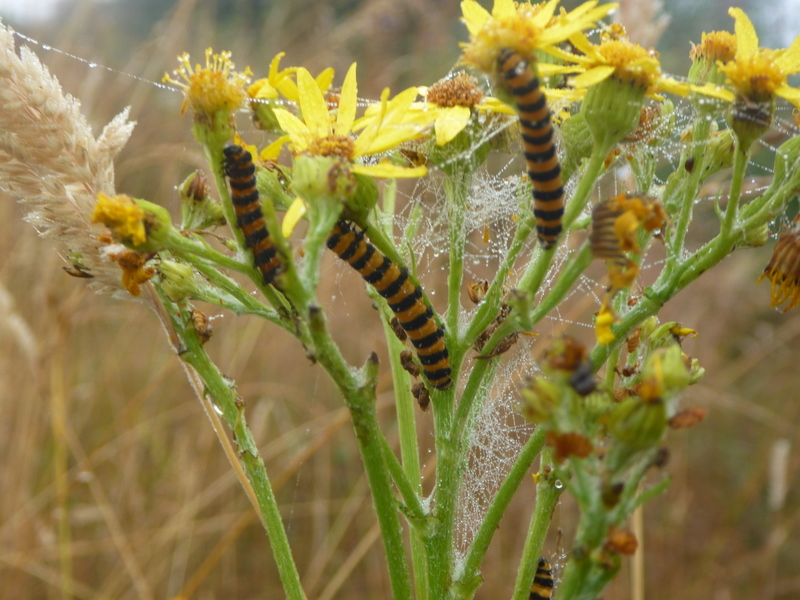
A nasty weed growing around here is Tansy ragwort, an invasive, toxic biennial weed from Europe most often found in pastures and along roads and trails.  It is a Class B Noxious Weed in Washington State and control is required.

Tansy Ragwort with the Cinabar larva eating away

When prevalent, tansy ragwort is on of the most common causes of poisoning in goats, caused by consumption of the weed found in pasture or hay.  Milk produced by affected goats can contain toxins.  Most goats will reject it, bukt some will eat it, especially if it is in their hay; its poisonous alkaloids are unaffected by drying.  Honey from tansy ragwort also contains the alkaloid.


They will strip the plant of leaves and flowers

The good news is the appearance of a moth that lays its eggs on tansy, called the cinnabar moth.  Spectacular success has been achieved controlling tansy ragwort in the Pacific Northwest region by releasing this animal, and we have it occurring naturally around our place.  In places where we don't see them we just pull the plant when it is flowering and compost the plant after cutting off the flowers.  Our compost pile is very hot with all of the goat manure and urine, so it can probably take the complete plant.