Friday, November 5, 2010

Raw Goat Milk - is it safe?

Healthy and Happy Goats!
I'm often asked if it is safe to use raw goat milk?  Michael, who parks near our homestead and walks a mile through the woods to his little house, once told me that it is either the best food in the world or the worst - I believe ours is the best.  Washington State Department of Agriculture has rules for licensed dairies on the handling of milk and requires the operator to get the temperature of the milk lowered to 42 degrees (F) within two hours.  To accomplish this we store our fresh milk between milkings in the deep freezer (in the barn set at -22 degrees F) until we are ready to bring it in the house to strain.  We strain the milk into quart Mason jars that are stored in the deep freezer (in the house) and then let it cool in an ice bath for another 1 and 1/2 hours before putting it in the refrigerator.

All of our milk containers are either washed in the dishwasher on a high temperature sani-wash cycle or washed by hand using soap, Clorox and scalding hot water.  Once a month we use a special chemical on all of our milk pots to cut the milkstone (the milk protein that builds up on the metal pots).

Quart jar of goat milk sitting in bath of ice cold water - be sure to bring water to top of the milk level.  A bucket of crushed ice would be best but I don't have an ice maker.
Barn cleanliness is also important.  We remove all of the straw bedding from the goat barn weekly and clean the milk stand after every milking.  We work hard to keep the rodent population as low as possible using barn cats, poison, and traps.  All feed buckets are stored in a way to keep rodents out of them.  We store our grain in metal cans with tight fitting lids and besides humans, no animals are allowed into the milk room other than the goat being milked.  We are not a licensed dairy as the rules for that are beyond our financial abilities.  We have a friend in Freeland who just went through the process to be licensed so she could sell her goat cheese to the public and spent over $200,000 building a State approved dairy for just 20 some goats.  We are talking multiple enclosed  rooms with special walls, special ventilation systems, concrete floors...People have been drinking raw milk throughout the world for 10,000 years without even using the safeguards we do and have thrived, so that is really overkill for us.

Our goat milk is strained through a new filter, never using cheese cloth or pillow cases.  The filter is rinsed out and thrown away after each batch of milk.  When we make cheese using raw milk, the cheese is strained in a clean cheese cloth (again, NEVER with a pillow case).  The cheese cloth is rinsed and washed in the clothes washer, and then before being used for cheese we sterilize it in boiling water for a few minutes.

Straining goat milk before going into ice bath to cool
Our goats are kept healthy, eating mostly organic products (grain, hay and bedding straw are certified organically grown) and have a large pasture of grass, stinging nettle, and brambles.  We only treat our goats with antibiotics if they have a problem and our vet recommends such treatment.  We use a chemical to treat for worms, but again only if they have the symptoms.  Before milking we wash their utter, teats, and belly with a chemical wipe specifically made for this.  After milking we use a teat dip to sterilize the teat.  We test monthly for bacteria in the milk and annually for four goat problems: CAE virus, Johne's disease,  Bruelloiss and CL - the four nasty goat diseases.  All of our goats have tested negative.  We check for lice on a regular bases (the usual problem time is spring just after they give birth), and treat if they are infected with a powder insecticide. And, of course, we wash our hands on a regular basis, in between milking the individual goats, and always when returning from the barn.  It's a lot of work keeping dairy goats and lots of responsibilities if you are going to use raw milk. 

I put a couple of links to raw goat milk up top and if you are interested in raw milk, they are good reading.

Thursday, November 4, 2010

Our Chicken Crop

In April of 2009 we introduced chickens to our farm.  Why did we wait so long?  We started with ducks because Pam had an allergy to chicken eggs AND ducks are so much easier to raise.  Ducks are dirty (they can foul a bucket of water in five minutes or less!) but have few diseases and will thrive on little grain along with bugs and grass, of which we have an abundance of both.  Chickens need nest boxes and roosts, clean water and lots of food, so we waited.  In time Pam's allergy to chicken eggs ended so the next phase of our animal care began.

Rocky the Rooster with some of his girls
But what is a farm without chickens?  So in 2009 I built a chicken coop on a very limited budget.  We put an ad in the local weekly looking for a free, old truck canopy to use as the roof and received so many calls that we then demanded free delivery.  We ended up with one that came with a galvanized hanging feeder and waterier.  I did have to purchase some lumber but I had it completed before the chicks arrived.

One of the local feed stores we use were giving away day-old chicks if you purchased items from their farm store, so we saved our receipts and got 15 free Rhode Island Reds (all girls) on April 15th of 2009.  They began laying their first eggs in late summer.  We chose the Rhode Island Red for a couple of reasons: they are considered a duel purpose bird, a very good egg layer of large brown eggs and also an above average meat bird.  Our plan is to keep the layers for three years and then butcher them.  We eat about a dozen eggs a week and were getting a dozen eggs a day so I went into the egg selling business and have been able to sell all of our excess eggs to co-workers.

We have lost a couple birds to who knows what, finding them dead on the floor of the coop or in their nest, and we lost one to a hawk, but over all they have done well.  We wanted a rooster so we ran an ad on Craigslist for a Rhode Island Red rooster and got a young one who the owner called "Boy Model" - we renamed him Rocky.  Yes he is a beautiful bird and is very good with his girls, but Rhode Island Red roosters are known to be mean to people, and he and I have had several fights.  Pam won't go into the area without a spray bottle of water to squirt him.  That seems to work well.

Even with nice nest boxes the girls like to find hidden places to lay their eggs, often adding the to the duck nests.  When one of our ducks became broody this last spring it seems she also had several chicken eggs in her nest and one day hatched a Rhode Island Red chick.  Chicken eggs hatch about 15 days before the Muscovy so our duck had this chicken to care for.  The nest was under the chicken coop and I could watch the going on.  As "Chick-Chick" grew she would roost on the head of the duck, whose duck eggs never hatched.  So cute!  Chick-Chick has grown into a fine bird, a rooster and has been renamed Junior.  He looks just like his Papa.  Last week he started to crow, if his crow matures into one we like it's the stew pot for Rocky - there is no place here for a mean rooster!

"Chick-Chick" with his mother the Duck
This last April we ordered our first set of meat birds.  I took a class at the local Grange on raising meat birds and much of the discussion was on what type of bird to select.  The standard is a white bird, Cornish x Rock, which has been developed to EAT and put on weight.  It's what all of the commercial chicken growers use.  Six weeks from hatch to the freezer, but they have major problems.  They are said to be so dumb that turkeys look like Einstein and have been known to die of thirst because they won't walk three feet to the water.  Free range is a joke as they won't eat grass or bugs, just grain.  Because they grow so fast they are known to have problems with their legs and 15 to 20% often die for unknown reasons.

The instructor had success with the Red Rock (aka Red Ranger), which is what we ordered.  They take three months to mature but over that time eat about the same amount of grain as the Cornish Rock.  We received 50 in the mail one fine morning and I put them into the new meat bird house I built.  They grew into a fine looking bird, somewhat like the Rhode Island Red but with a little more black in them.  The instructor also had built a chicken plucker and would rent it out for 50 cents per bird.
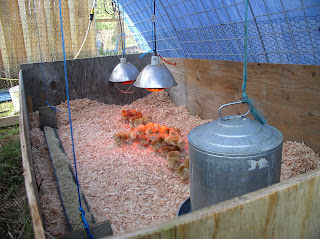
Our day old Red Rock meat birds
In August of this year we rented the plucker for a day and processed all of the boys, 22 of them.  We lost four birds to who-knows-what and three to a local fox, leaving us with 43 to butcher.  We waited two weeks to do the girls, giving us and them a break and also allowing the girls a little time to put on more weight.

The meat bird house
Slaughter day was not very difficult.  My job was to get the bird, bring it out to the barn area and dispatch it.  We had a 4x4 board with four feed sacks on it, I put the bird upside down in the sack and cut its juggler vein with an exacto knife (with a new blade) and bled it out.  The idea is to keep the heart pumping the blood out of the bird before it dies, giving it better meat than cutting off the head, which kills it outright.  I would then remove the dirty feet and could put three at a time in the chicken plucker.  The plucker has rubber fingers in the tub which removes almost all of the feathers as the birds gently tumbles.  Plucking takes about one minute per three birds!

We had a table set up with two large trash cans filled with ice water.  Once Pam gutted and cleaned the birds they went into the ice water.  We processed 22 birds in about four hours from start to finish.  The boys dressed out a 6.5 lbs, the girls at 4.5 lbs.  43 birds went into the freezer for our year's supply of chicken. Our cost was about $10 per bird.  Free range, organic chickens in the local supermarket sell for about $20, and are shipped in from across the country, and who knows if they are really "free range" or just have the option to go outside.  Ours spent all day in the tall grass in a pasture that has never had pesticides sprayed and ate only organic grain.  The only change we'll make this year is to do a better job on grounding the electrical poultry netting I used around the pasture.  I didn't do a good job on that this year and the jolt from the fence was not strong enough to keep the local fox out.  One of my spring projects for sure.

Wednesday, November 3, 2010

Winter Projects

My to do list for this winter is large.  My first project is to finish enclosing the goat-buck house.  I converted an old deck my children and I built for the trailer Pam and I lived in while we built our house.  We lived for two plus years in a large travel trailer and the porch was a life saver, giving us a clean, dry entry way plus a place to story things.  After moving into our house we used it to store firewood and when we started keeping male goats, I enclosed three of the sides for the boys.  Too much rain gets in so I'm going to enclose more of it.  They need a dry place somewhat out of the wind for when the weather is nasty.  Because they spend so much of their time under the eve of the barn near where the girls live, I'm also going to make a little shelter there.

Our old home while building the house - the deck is now the buck house
Our old deck with the year's squash harvest
Next on my list is a greenhouse.  Today I will go to the county planning department in Coupeville to turn in our plans along with the paperwork for the building permit. The greenhouse will be attached to the east side of our barn, 24' wide and 18' deep.  The site has very good sun exposure.  My estimate for the cost is about $2,000.  Covering will be a product called Soleex, a flexible, insulated twin-wall polyethylene product which is said to last over 20 years.  We'll have inside raised growing beds along the east and south sides of the greenhouse to allow us to grow tomatoes, peppers and basil (crops we have not been able to grow in our garden) and benches to start all of our vegetables and Pam's flowers.  The county planning department told me it takes six to eight weeks to get the permit, so I have a little wait on that.

Our barn after completion - the greenhouse will be on the right side
Next on the list is a new chicken coop.  Our girls are entering their third year of life and even though their eggs are getting really large, production is dropping off.  We need a place to grow the next set of girls so we think a new wing to the existing house is the way to go.  If we get chicks in the spring they will be laying by fall.  We'll then butcher the older girls, making stewing hens out of them.

Monday, November 1, 2010

Meat Processing at our Farm - the Muscovy Duck

We raise Muscovy ducks mainly for their eggs and to sell the ducklings.  The Muscovy duck is considered duel purpose, laying a lot of very large eggs and the male (called a drake) grows very large and is coveted for its dark, red looking meat.  The hens start laying in February, usually about five eggs per week, and the eggs are just as good as a chicken egg but much larger.  We gather all the eggs we can find but once the nettle begins to grow and gets large we start to miss some of the nests.  After a duck get about 15 eggs in her nest she becomes broody and disappears, sitting on the eggs for the next 35 days or so, until she emerges with 10 to 12 ducklings.  We then try to sell all of the ducklings we can, usually 70 or 80 in a year, along with most of our grown hens.  What we are left with becomes our new flock and meat birds.
Two ducklings waiting their turn

Yesterday I butchered six young drakes.  The feathers are very difficult to pluck so I skin them.  Most of the fat is in the skin layer so it also makes for a lean meal.  We do not feed our birds any corn so they don't put on much fat (I believe the commercial growers finish them on corn to bulk up their weight, corn being cheep and selling the birds by the pound adds to their profit).  I remove the wings as they are too difficult to skin and we lose a little weight and meat because of that.  Ours dressed out at 4.5 lbs, not bad for no skin or wings, and they are considered "ducklings" - they are not full grown.  Full grown Muscovy drakes will dress out around 8 lbs.  We slow cook them all day in a crock pot and the dish will give us four meals or so.  We have another four to process but will wait another 30 days or so as they are younger.

"Dispatched" duckling with the box I used in the background
My job is to catch the birds, dispatch them from this life, and skin them.  I then bring them into the house and Pam cleans and wraps them for the freezer.   I believe the best way to dispatch them is to put them in a box I constructed that is attached to a pole, head down.  Their blood runs to their head and it kind of makes them drunk; I then cut their juggler vain with a very sharp blade to bleed them out.  The complete process takes me about 30 minutes per bird, and we ended up with 25 lbs of meat for the freezer.

Pam not only cleaned and wrapped the ducklings yesterday, but made a batch of goat milk/oatmeal soap.  All of this accomplished and we still made it to a Halloween potluck dinner by 4 pm.  At the outdoor fire ring we talked of our ancestors who have passed before us, I talked of the six ducklings that gave their bodies to us this day for nourishment.     

Pam making goat milk/oatmeal soap

Friday, October 29, 2010

Fall Cheese Making

This morning I made a pound of mozzarella cheese for Pam to use in her lasagna for tomorrow's dinner.  Our recipe is from Ricki Carroll's book Home Cheese Making and is called 30-Minute Mozzarella, and really only takes 30 minutes and comes out perfect every time. Sunday I started two pounds of feta cheese, probably my favorite cheese this year.  We also have a simple recipe for Ricotta cheese made with whole goat milk (vs. the traditional recipe using whey from hard cheeses).  Ricotta cheese freezes well so I won't make any for tomorrows meal as we have a good supply in the freezer.

Mozzarella Cheese ready to cool off in the refrigerator

Feta Cheese ready for brine
Feta is much more difficult to make correctly than Ricotta or Mozzarella and takes several hours of close attention.  Our problem in the past has been getting hard curds.  Soft curds and the cheese dissolves in the salt brine, but when it comes out good it is the best feta I have ever tasted.  We add the soft feta to dishes we cook and save the firm feta for salads and eating by itself.

Next year we are going to start making hard, aged cheeses.  Hard cheeses need to age several months at 55 degrees and high humility, so we need to get a new refrigerator.  I need to start looking for a used one soon and we will keep outside in a protected area next to the pump house.  I'm not concerned about energy use (of an old one) as we will be keeping the temperature somewhat high (at 55 degrees). 

Wednesday, October 27, 2010

Coyotes

I woke up at 2:30 am this morning to the sounds of coyotes outside our bedroom window.  What strange sounds they make after a kill.  We lock down all of our birds every evening and the goats are in a six foot fenced pasture with electrical wire along the top.  I have chicken wire on the bottom bent over a foot and stapled down to the earth.  With the does we have a livestock protection dog living full time.  So far we have not lost any livestock to them, but we do lose barn cats.

Everyone that has livestock has rodents, rats, mice and voles.  It's almost impossible to keep 100% of the grain contained and these nasty rodents feast on it.  They will also pick apart the goat dung to eat undigested grain.  Dairy goats and chickens cannot be raised without grain, so we have an abundant rodent population.  Washington State Organic Standards allow us to use a rodenticide (vitamin D), and we do, but it only contains the population at manageable levels.  We also keep barn cats.  We get our cats from rescue organizations and our place is the last stop for cats they can't place in a home.  We have two large cages in our barn loft for new cats where we keep them for two weeks, then we open the door and they are on their own.  We keep a good quality cat food, fresh water and a litter box in the loft, and they have a ramp to get down and outside.  The life expectancy at our farm is not long for a cat.  We are very remote, bordering the State Park and large undeveloped wooded properties, so the predators are abundant here.  The Great Horn owl and the coyote are the main predator of our cats.  Our best hunter was Gray Paws, and she was eaten about a month ago.  She used to line up her nightly kills along the driveway for us to see in the morning.  We currently have two cats that won't leave the barn loft so they are safe;  Greta wanders - we'll see if she made it through the night later this morning.  It's a short life here at our farm for cats, but the cat people we use say it's much better than the animal shelters.
Oyster Mushrooms growing on an alder log

Monday I collected oyster mushrooms on an alder tree that blew over in the nasty winter of 2006-2007.  We have harvested nearly 10 lbs. this fall and I'll take another two pounds this afternoon.  I fry them in a little olive oil and add them to stir fry with vegetables from our garden and panir.  Panir is a goat cheese we make and use as the main protein source for one or two meals each week.  It's easy to make; I heat five quarts of goat milk to 195 degrees and keep it between 190 and 195 for 10 minutes, add a couple of gulps of vinegar, put it in a cheese cloth to drain for about two hours, refrigerate it for six hours, and it's done.  I cut it into 1/2 inch cubes and broil it after mixing it with spices and oil and add it to the stir fry.  It doesn't melt when heated like most cheeses and can be used in any dish as you would tofu or cubes of chicken.  It's almost unknown in the US but everyone that samples it loves it.  Tonight I'll make it with a peanut sauce and sauteed vegetables. 
An old fallen alder tree growing oyster mushroom on our land
Update on Greta: she made it through another night, waiting for me in the barn to get her morning lovings.

Monday, October 25, 2010

Organic Goat Milk

We feed our goats organic grain and organic alfalfa pellets, but have not been able to find organic hay or organic straw (straw for bedding) locally.  I have found farmers growing them in Eastern Washington but I would need to buy a truck load at a time and I don't have a place to store that much product.  Our barn is small (24' x 24') and the goats take up 2/3rds of that.  We keep our tools, freezer and bikes in the one 12' x 12' section leaving us with only room for 9 or 10 bales of hay and straw.  For a semi-truck load I would need a separate poll building just for that.  Nice dream but it's not going to happen soon.

We have been buying our hay from a Coupeville farmer that uses no herbicides but does treat his fields with synthetic fertilizers.  The goats have enjoyed the alfalfa/grass/weed mix and have been buying the straw (barley) from a different farmer.  I asked that farmer last month what herbicides he used and was shocked with what he uses.  That put us back in the hunt for a better product.

Surely with one of her boys on a bed of barely straw
We called another Coupeville farmer that rumor had said grew organic barley.  It turns out that in addition to organic barley he grows organic alfalfa, organic emmer wheat and an organic grass. We chose emmer wheat straw for our bedding as it has less chaff than the barley.  Barley chaff gets in our cloths and shoes and is a real irritant.  At times it can also bother the goats, making their utters breakout in a rash.  The problem with regular wheat straw as bedding is that the stalks are large and they don't absorb urine well.  Emmer wheat doesn't have the chaff and has smaller stalks - maybe our ideal bedding straw.  Organic standards for Washington State requires bedding to be organic.  Later this week we will get a load of organic alfalfa for the girls and his organic grass for the boys.  We still feed the goats sunflower seeds and peanuts, neither of them organic.  If we could find an organic source for those two products we would have pure, organic, goat milk.  A work in progress.